
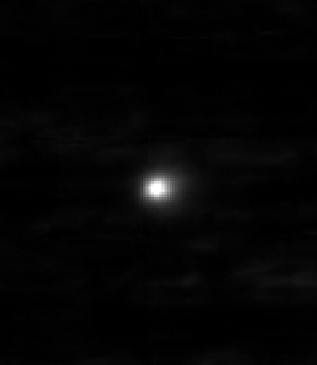
A First Glimpse of the Interstellar Comet 3I/ATLAS
Cyrielle Opitom and collaborators present early VLT/MUSE observations of the interstellar comet 3I/ATLAS, revealing a red, dusty coma but no detectable gas at 4.47 au from the Sun. Its color is redder than typical comets, resembling distant Solar System bodies. Future observations will track its activity and test predictions about its composition.

Tracing the Past: The Ancient Metal-Poor C-19 Stellar Stream Extends Over 100 Degrees
The C-19 stellar stream, one of the most metal-poor structures in the Milky Way, has been found to extend over 100 degrees in the sky. Using Gaia data and advanced algorithms, researchers identified 12 new members, confirming its ancient origins. The stream is wider and more dynamically hot than expected, suggesting early disruption by dark matter or stellar interactions. These findings provide new insights into the formation of the first stellar structures in our galaxy.

Unveiling Three New Stars: Rare Hot Pre-White Dwarfs Discovered
Astronomers discovered three rare hydrogen-deficient pre-white dwarfs with helium-dominated atmospheres. These include an O(He) star likely formed from helium white dwarf mergers, a PG1159 star with the lowest known surface gravity in its class, and a CO-sdO star formed from disrupted white dwarf mergers. Their unique characteristics shed light on unconventional stellar evolution pathways.

The Riddle of Cosmic Heavyweights: How Stars Forge Elements in the Early Universe
The CERES project investigates how early stars formed heavy elements through neutron-capture processes. Focusing on 52 ancient metal-poor stars, the study found that the rapid r-process dominated at low metallicities, while the slower s-process emerged later. Variations in element abundances suggest diverse nucleosynthesis events, with findings aligning well with galactic chemical evolution models, shedding light on the universe's early chemical enrichment.

Tracing the Chemical Fingerprints of Early Stars through Elemental Patterns in the Milky Way
This study examines the chemical evolution of elements like carbon, nitrogen, oxygen, and lithium in 52 metal-poor giant stars in the Milky Way’s halo to understand the early Galaxy’s chemical history. By analyzing patterns in “mixed” and “unmixed” stars, the researchers found that mixed stars show evidence of internal processes altering their elemental composition, while unmixed stars retain the chemical signature of the early Galaxy. Lithium detection in some stars supported this classification, and stellar rotation was identified as a crucial factor in explaining observed nitrogen levels.