
Unveiling HIP 8522: A Curious Young Solar Twin with Puzzlingly Low Lithium
HIP 8522 is a young solar twin with an unusually low lithium abundance, significantly lower than expected for a star of its age. Lithium is typically depleted gradually in stars, but HIP 8522, despite being less than 1 billion years old, shows a level similar to much older stars. The study suggests two possible explanations for this: HIP 8522 could be a field blue straggler formed from a stellar merger, or it may have undergone episodic accretion, possibly engulfing a nearby object early in its history. This star challenges existing models of stellar evolution, particularly regarding lithium depletion.
Starspot Activity and Rotation of SZ Piscium: A Doppler Imaging Study
This study examines the magnetic activity and rotation of SZ Piscium, a binary star system, using Doppler imaging to map starspots on the surface of its K-type subgiant star. The researchers observed widespread starspots, including a stable polar spot, and measured the star's differential rotation, finding that its equator rotates faster than its poles. They also confirmed the presence of a third companion star in the system, orbiting with a period of 1530 days.

Searching for Planets Around Vega: A Summary of JWST Observations
Astronomers used the James Webb Space Telescope to search for planets around Vega, a star known for its prominent debris disk. While they detected two distant objects, these were likely extragalactic sources, not planets. The study set strict limits on the possible sizes of any planets in Vega’s system, ruling out planets larger than Jupiter within 10 AU. The smoothness of the debris disk suggests that any planets present are likely smaller than 0.3 times the mass of Jupiter.
The Early Rise of Nova V1674 Herculis: Unveiling the Secrets of Fast Novae
The paper by Quimby et al. (2024) discusses the early stages of the outburst of Nova V1674 Herculis, a fast nova observed in unprecedented detail from 10 magnitudes below its peak brightness. The authors analyze the nova's rapid rise, which showed three distinct phases: a slow, fast, and faster rise, captured by high-cadence observations from Evryscope. They propose models that explain this rise by the expansion of the white dwarf's outer layers, though some features, such as the rapid transitions, remain unexplained.

A Low Metallicity Binary Star Discovery in WLM Galaxy: A Glimpse into Stellar Mergers
Maude Gull and her team discovered a low-metallicity contact binary star system, WLM-CB1, in the WLM galaxy using data from the Hubble and James Webb Space Telescopes. This system, composed of two massive stars, is significant for its extremely low metal content, making it a unique case to study stellar evolution. The stars are likely in a contact phase, possibly leading to a merger in the future, which could result in a supernova or black hole. Further observations will help confirm the system’s nature and refine models of binary star interactions in metal-poor environments.
Exploring the Milky Way's Proto-Galaxy: A Chemical and Structural Investigation Using APOGEE-Gaia
This study by Horta and Schiavon uses data from the APOGEE and Gaia surveys to investigate the Milky Way's proto-galaxy—its earliest stellar components. By analyzing the chemical compositions and distribution of ancient stars, the authors identify distinct populations, including those from the galaxy's main progenitor and from past mergers like Gaia-Sausage-Enceladus. Using a Plummer model, they estimate the mass of the proto-galaxy to be about 9.1 x 10^8 solar masses, providing insights into the early formation of the Milky Way and its structural evolution.

Star Formation History of Gaia-Sausage-Enceladus: What Elemental Abundances Reveal
The study by Ernandes et al. investigates the star formation history of the Gaia-Sausage-Enceladus (GSE) galaxy using elemental abundances from its stars. The results show that GSE's star formation began gradually and extended for over 2 billion years. However, it ended abruptly, likely due to its merger with the Milky Way. Comparing GSE's chemical patterns to dwarf galaxies like Sculptor and Fornax reveals that GSE's history was similar to Fornax's slow growth but was cut short by external forces.
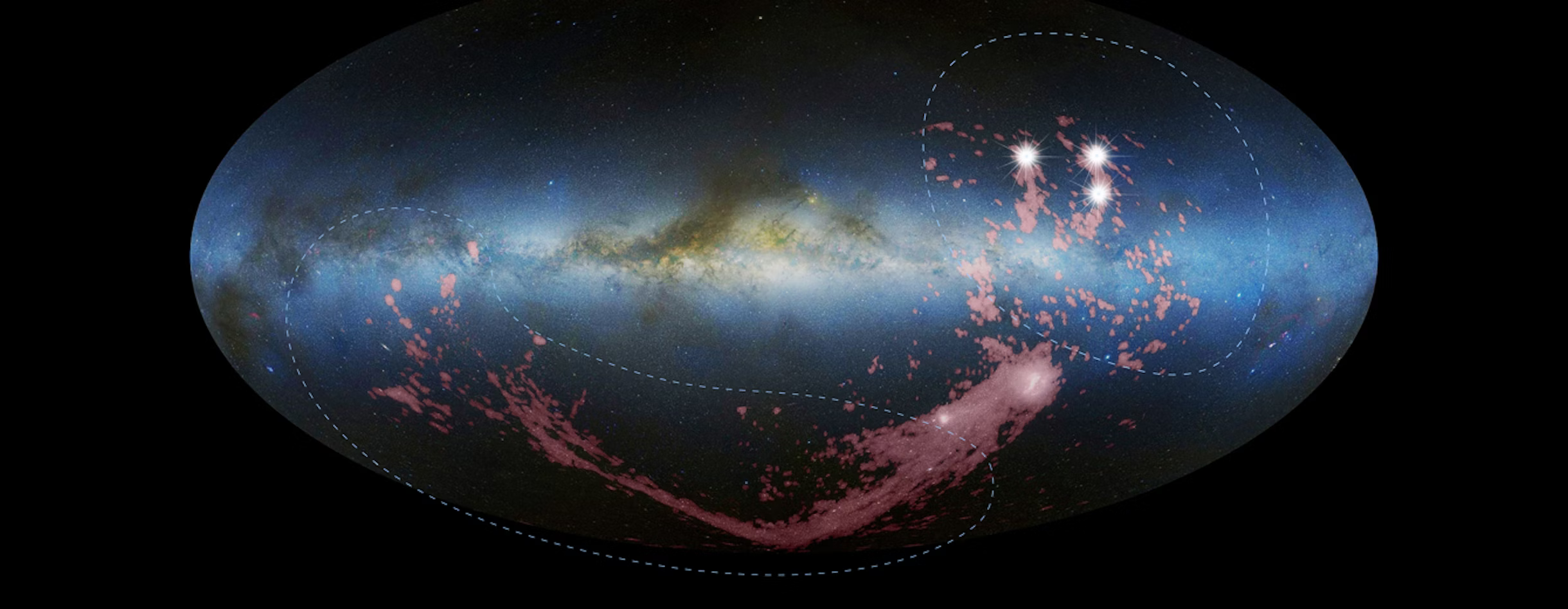
Following the Tidal Trail: Understanding the Magellanic Stream
The Magellanic Stream is a vast trail of gas extending from the Large and Small Magellanic Clouds, dwarf galaxies orbiting the Milky Way. This structure, formed through tidal and hydrodynamic forces during the galaxies' interactions with each other and the Milky Way, has been mapped using radio observations. The Stream's composition and motion suggest that it was stripped from the Clouds during their first encounter with the Milky Way. While much progress has been made in understanding the Stream, open questions remain about its origin, distance, and ionization processes, which future research will address.
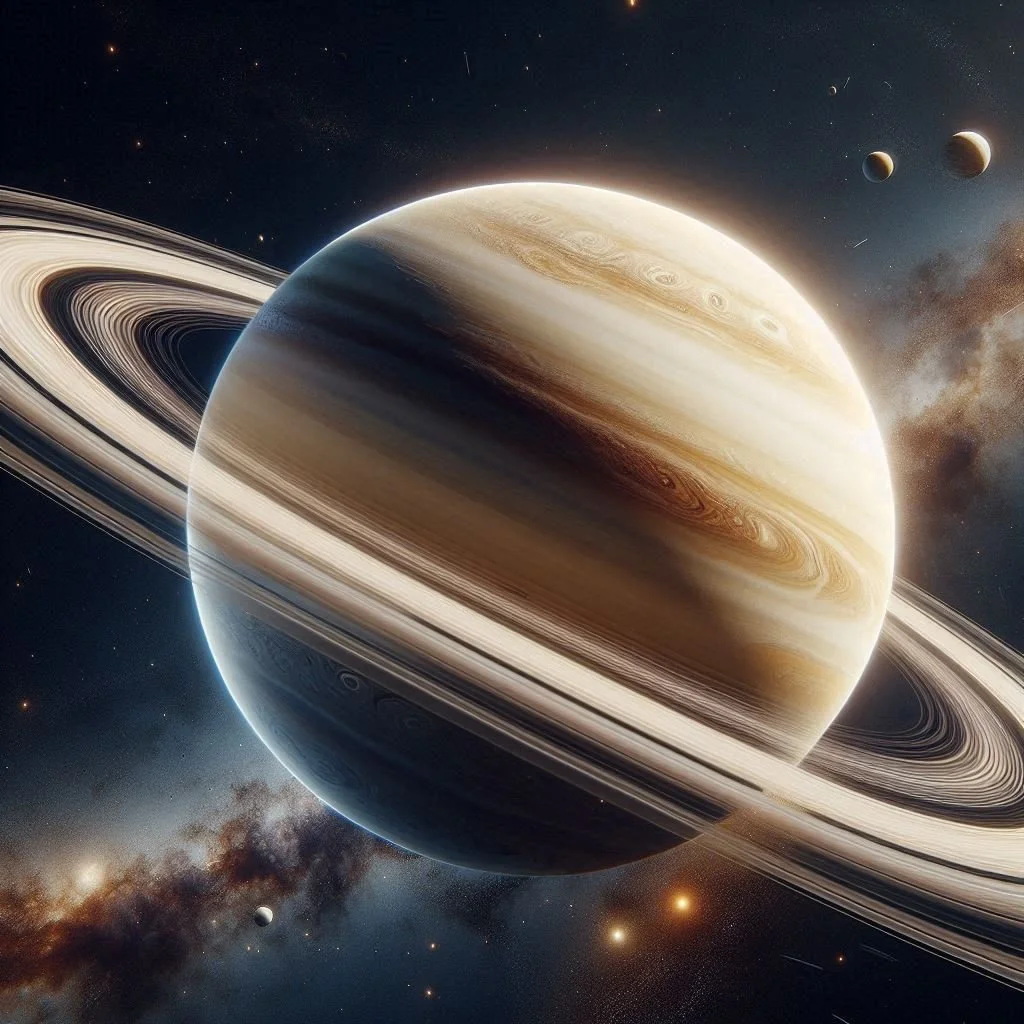
Revisiting HD 28185: The Surprising Discovery of an Outer Planet in a Saturn-like Orbit
Astronomers recently revisited the exoplanet system around the star HD 28185, leading to a surprising discovery. While it was already known to host a giant planet with an Earth-like orbit, new research by Alexander Venner and his team revealed a second planet, HD 28185 c, previously thought to be a brown dwarf. This outer planet, about six times the mass of Jupiter, follows a Saturn-like orbit, making it one of the most distant exoplanets detected through radial velocity and astrometry methods. The findings offer exciting insights into how distant giant planets may be more common than previously thought.