
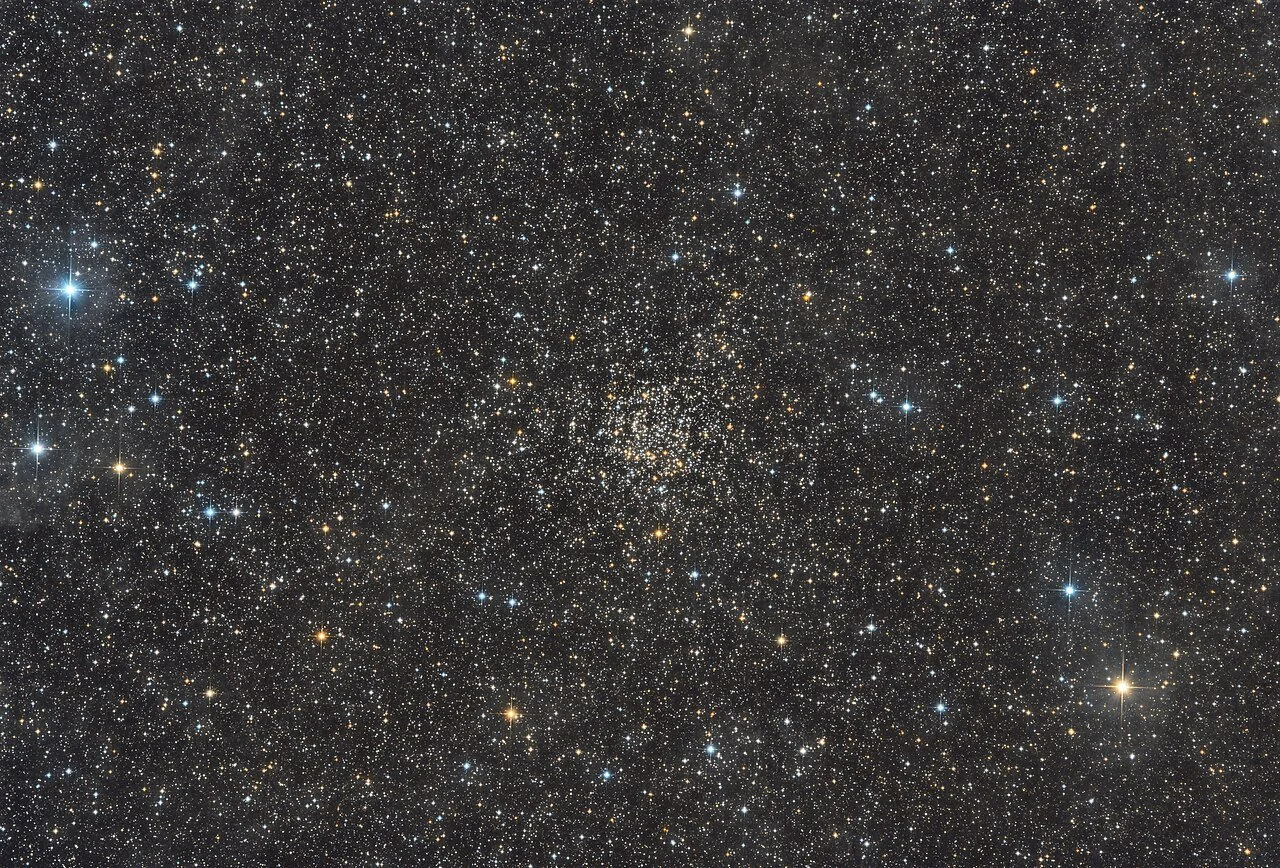
Binary Star Clues Reveal a Sharper Age for Star Cluster NGC 7789
Yakut and collaborators use six well-measured binary systems in NGC 7789 to derive a precise, physically grounded cluster age. By combining radial velocities, TESS light curves, and multiwavelength SEDs, they determine an age of 1.26 ± 0.09 Gyr, an extinction of Aᵥ = 0.90, and confirm cluster membership through Gaia astrometry. Their binary-based method overcomes common photometric uncertainties and provides a consistent framework for studying stellar evolution.

Unraveling Nephele: The Hidden Galaxy Behind Omega Centauri
Pagnini et al. (2025) reveal that Omega Centauri was once the core of a vanished dwarf galaxy named Nephele. Using stellar chemistry and motion data from APOGEE, they identify hundreds of stars once belonging to this system. Their findings suggest Nephele’s remnants form extended stellar streams, showing how the Milky Way grew by merging with smaller galaxies.

Liller 1: A Galactic Mystery, Uncovering the Origins of a Massive Star Cluster in the Milky Way’s Heart
Anna Liptrott and colleagues used APOGEE data to study whether Liller 1 helped form the Milky Way’s bulge. By comparing its chemical makeup with stars from the bulge and disk, they found that Liller 1’s α-element abundances differ significantly, showing it’s chemically distinct. The results rule out it being a major bulge “building block,” suggesting instead that Liller 1 is a minor or possibly extragalactic remnant.

Binary Stars Illuminate the Secrets of NGC 2506: A Precise Age and Distance for a Middle-Aged Star Cluster
Kadri Yakut et al. used data from Gaia, TESS, and ground-based telescopes to analyze five binary stars in the open cluster NGC 2506. By jointly modeling their light, velocity, and energy distributions, the team derived a precise cluster age of 1.94 billion years and a distance of about 3,200 parsecs. This method demonstrates how binary systems can accurately reveal a cluster’s age, distance, and evolutionary state.

Breaking Up Star Clusters: The Source of Blue Light in NGC1275
NGC1275, the central galaxy of the Perseus Cluster, shows unusual bluish light in its inner regions. Levitskiy and colleagues argue this glow comes from the tidal disruption of super star clusters formed about 500 million years ago, triggered by activity from the galaxy’s black hole. The surviving clusters, disrupted stellar streams, and central spiral disk all fit into this unified scenario.
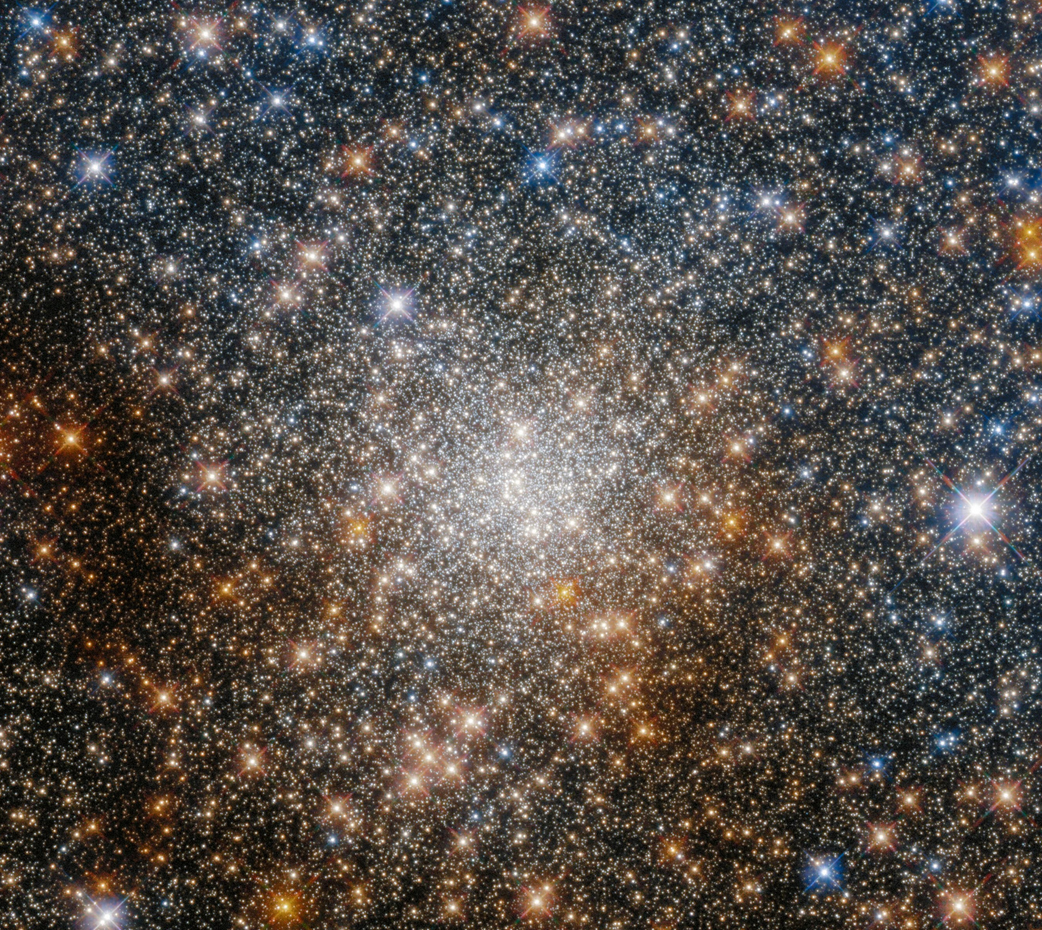
Decoding the Origins of Globular Clusters with Magnesium and Aluminum Clues
Lin et al. use magnesium and aluminum abundances in ancient stars to classify globular clusters as either formed inside the Milky Way or accreted from other galaxies. By focusing on primordial stars within clusters, they reveal a clear chemical distinction that remains robust across datasets. This method offers a reliable alternative to traditional orbit-based classifications.
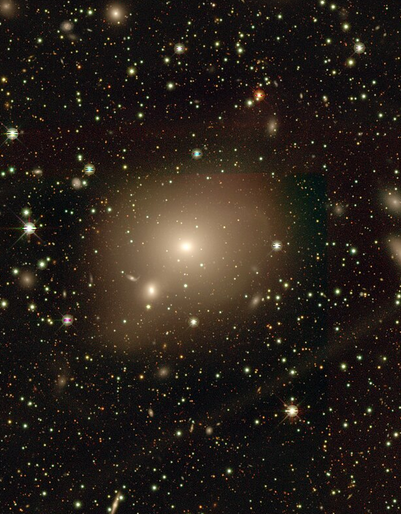
A Bridge Between Giants: Tracing the Past of NGC 4709 Through Its Star Clusters
This study investigates NGC 4709's globular cluster system to trace its interaction history with NGC 4696. The clusters show a bimodal color pattern and spatial alignment pointing to a past encounter. A bridge of clusters between the galaxies and differing distances supports a high-speed flyby scenario, with future work planned using simulations to model their trajectories.
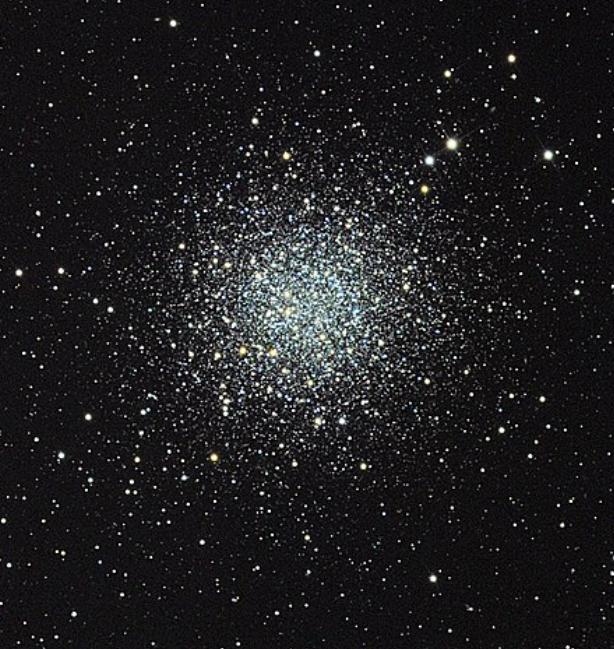
Unveiling the Faint Edges of Star Clusters in the Milky Way
Chiti et al. used DELVE survey data to search for faint, extra-tidal features around 19 Milky Way globular clusters. They discovered a clear stellar envelope around NGC 5897 and tentative evidence around NGC 7492. Simulations suggest deeper surveys like LSST can improve detections, though additional techniques may still be needed.

Tracing the Milky Way’s Past: How Globular Clusters Reveal the History of the Gaia-Sausage-Enceladus Merger
Fernando Aguado-Agelet and colleagues studied 13 globular clusters linked to the Gaia-Sausage-Enceladus (GSE) merger to trace the Milky Way’s history. They found most clusters follow a clear age-metallicity pattern, with two distinct star-formation bursts about 2 billion years apart, likely triggered by GSE’s interaction with the Milky Way. Two clusters probably formed in the Milky Way, and two others may belong to different mergers.

The Secrets of a Shattered Cluster: Uncovering the Past of ESO 280-SC06
ESO 280-SC06 is a faint globular cluster with unexpectedly high levels of chemically enriched second-population stars. Analysis suggests it was once much more massive but lost most of its stars due to tidal disruption. The discovery of a rare nitrogen-enriched star hints at a less dense environment that allowed binary interactions.
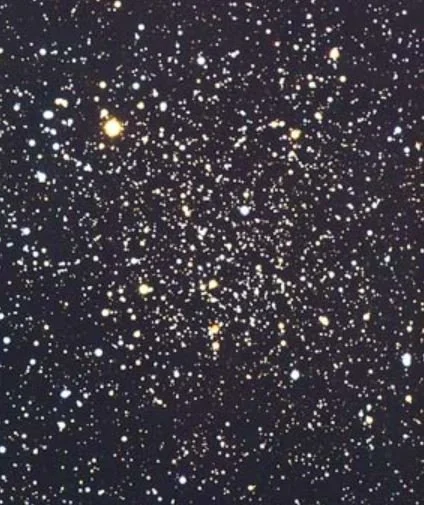
Peering Through the Dust: Exploring the Metal-Poor Open Cluster Trumpler 5 in Infrared
This study used infrared spectroscopy to analyze seven red giant stars in the dust-obscured open cluster Trumpler 5 (Tr5). The team developed a new method to estimate stellar gravity and measured abundances for over 20 elements. Their findings confirmed Tr5’s metal-poor nature, estimated its age at 2.5 billion years, and enhanced understanding of stellar evolution in dusty regions of the Milky Way.

Tracking Star Movements: What NGC 2808 Reveals About the Lives of Star Clusters
This study of NGC 2808 shows that its different stellar populations move separately, especially in the cluster's outer regions. Second-generation stars exhibit more radial motion, supporting theories about their central origin and outward diffusion. The cluster also shows partial energy equipartition, more developed near the center.

Clues from the Cosmic Past: Unraveling the Chemical History of NGC 2298
This study analyzes 13 stars in the globular cluster NGC 2298 using the Gemini South telescope. It identifies two stellar generations with distinct light element patterns and finds notable variations in heavier elements like Sc, Sr, and Eu. These differences suggest complex, uneven early chemical enrichment from supernovae and rare r-process events, highlighting the cluster’s dynamic formation history.

Clocking the Cosmos: Measuring the Ages of Milky Way’s Ancient Star Clusters
This study uses advanced modeling and Hubble data to estimate the absolute ages of eight Milky Way globular clusters. By comparing synthetic and observed color-magnitude diagrams, the authors find ages ranging from 11.6 to 13.2 billion years. Distance and reddening are the largest sources of uncertainty, and results support a trend of older ages for metal-poor clusters.

Painting the Chemistry of Star Clusters: Tracing the Origins of Stellar Populations through Light and Spectra
Dondoglio et al. combine photometry and spectroscopy to analyze chemical differences among stars in 38 globular clusters. They confirm widespread element variations between stellar populations and find strong links to cluster mass. Unexpected lithium patterns and chemically "anomalous" stars suggest complex formation histories. Their work offers new insights into how globular clusters evolved chemically over time.

Tracing the Origins of Globular Clusters Through Their Tidal Tails
Piatti analyzes simulated extra-tidal stars from Grondin et al. (2024) to test if they match real globular cluster tidal tails. While the tail widths align with in-situ formation, velocity dispersions suggest an external origin. The findings challenge assumptions about how stars escape clusters and imply that some clusters may have formed outside the Milky Way. This work highlights the need for refined simulations to better understand the galaxy’s history.
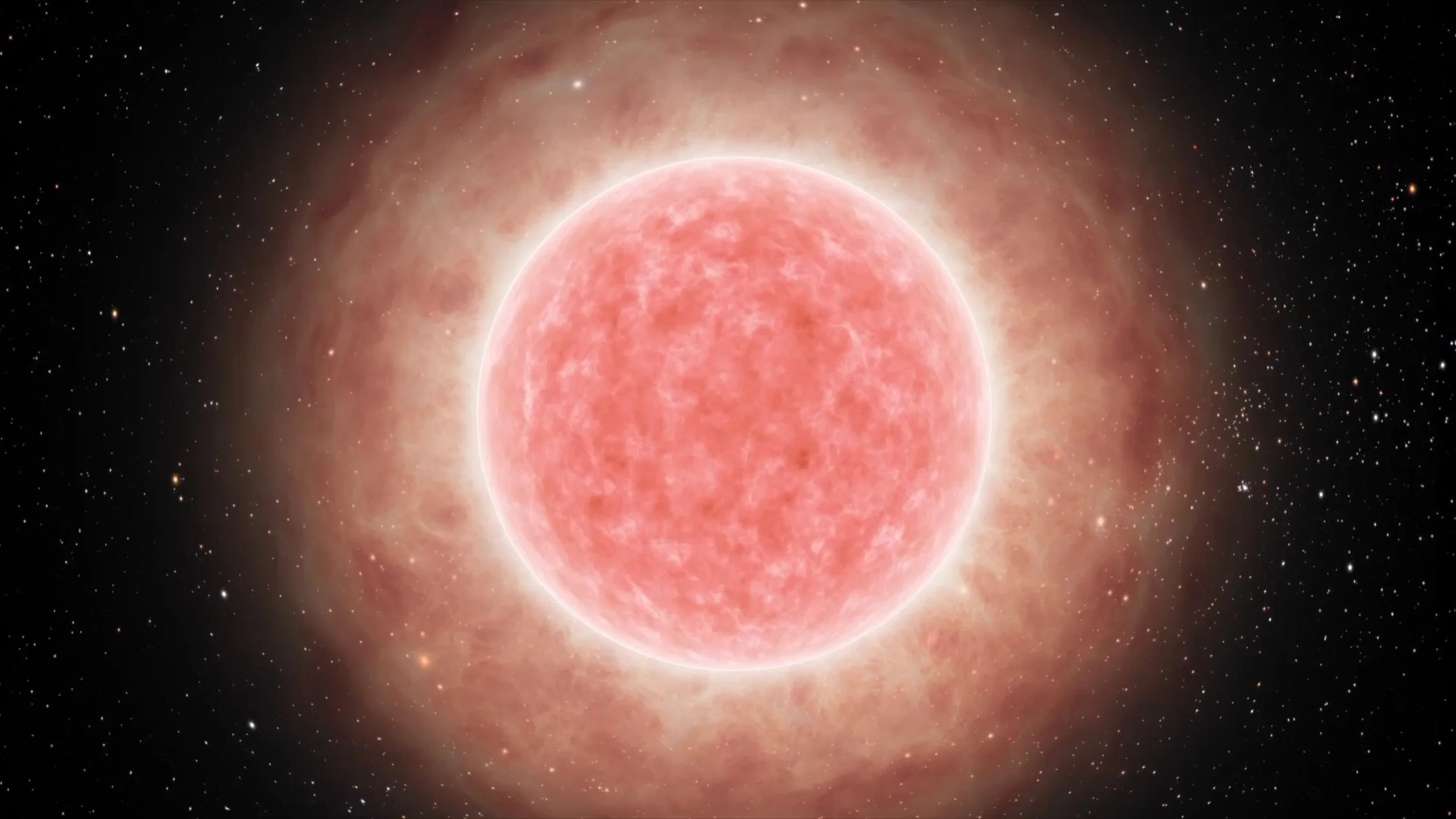
Illuminating the Red Giant Branch: Exploring Stellar Magnitudes and Metallicity
This study refines how metallicity affects the brightness of tip of red giant branch (TRGB) stars. It confirms that in the I band, TRGB stars are reliable distance indicators below a certain metallicity, but higher metallicity makes them fainter. Optical bands dim with metallicity, while infrared bands brighten, aligning with stellar models. These findings improve distance measurements and Hubble constant calculations.
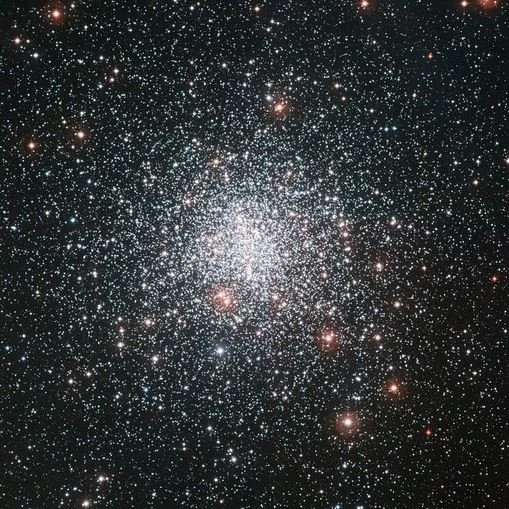
Exploring Ancient Stars: What White Dwarfs Tell Us About the Universe
This study examines white dwarfs in the globular cluster M 4 using JWST and HST data to refine age estimates and test stellar evolution models. Researchers confirmed theoretical predictions of cooling sequences and identified faint infrared excess in some stars, hinting at unexplained phenomena like debris disks or companions. The findings place M 4’s age at about 12.2 billion years, slightly younger than similar clusters, while future observations aim to unravel these mysteries further.

Charting Stars in Globular Clusters: Metallicity Patterns Among Stellar Populations
A study by Marilyn Latour et al. explores metallicity variations in globular clusters using MUSE and Hubble data. They found that P1 stars show significant metallicity spread, linked to cluster mass, while P2 stars often have smaller dispersions. These findings suggest complex formation processes, such as self-enrichment or hierarchical assembly, offering insights into the origins of these ancient stellar systems.

Unraveling the Secrets of Globular Clusters: Stars in Motion
The study explores the kinematics of 30 Milky Way globular clusters and their multiple stellar populations (MPs), analyzing rotation, anisotropy, and correlations with cluster properties. Using data from Hubble, Gaia, and spectroscopic surveys, the researchers found that MPs generally share similar rotational behaviors, with some differences tied to cluster age and dynamics. This work provides clues about globular cluster formation and evolution.